Endó
For iPhoneUnderstand your body. Shorten the path to answers.
Match your symptoms against peer-reviewed endometriosis research, then log them day by day — so when you walk into a doctor's office, you arrive with a record instead of a guess.
Theaveragetimefromfirstsymptomtoanendometriosisdiagnosisissixtotenyears.Recognisingyoursymptompatternearly,andhavingitwrittendown,isoneofthefewpartsofthattimelineyoucanactuallyinfluence.
Everything you need to walk in prepared
Symptom matching
Answer a 56-symptom questionnaire and see how your pattern compares to what women with diagnosed endometriosis actually report.
Your symptom match
4 of your symptoms
are strongly associated with endometriosis in the research.
- Pelvic pain outside your period
- Pain during or after sex
- Heavy bleeding
- Fatigue that rest doesn't fix
Daily logging
Pain, symptoms, mood and flow — with your cycle day and phase alongside them.
Pain this week
A plan, not generic advice
Your answers on remedies, diet, sleep and life impact become concrete action steps.
- Remedies that helped you before
- Sleep and rest adjustments
- What to track next cycle
Something to bring to your doctor
Months of structured symptom history in one place — the kind of record that's hard to reconstruct from memory in a ten-minute appointment.
What it actually looks like
Real screens from the iOS app — your cycle day, the symptoms you have logged, and the advisor you can ask about food and flares.
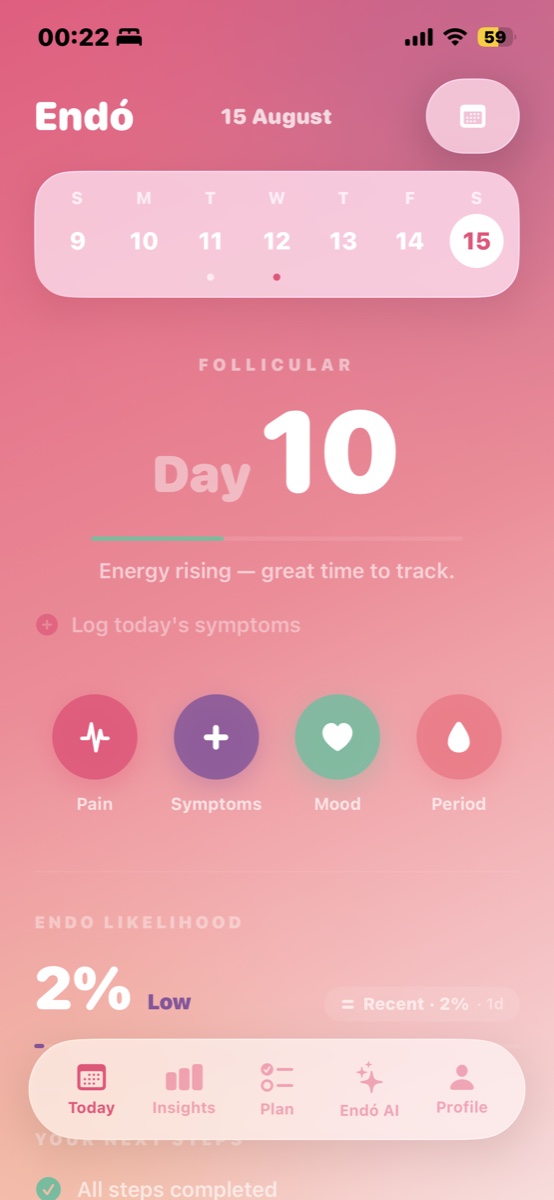
Today — your cycle at a glance 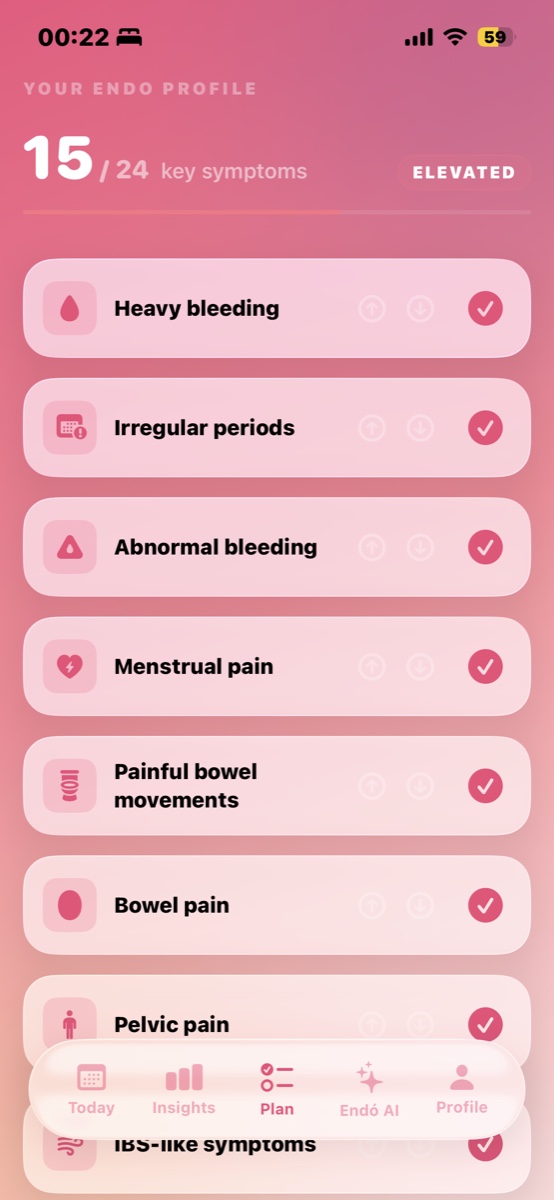
The symptoms you have logged 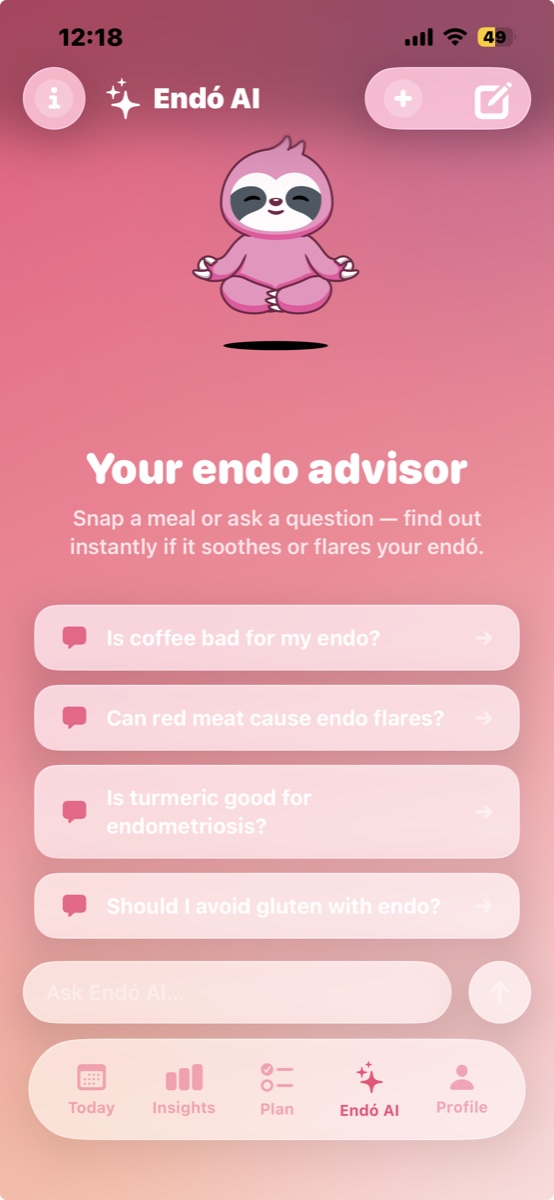
Ask about food and habits 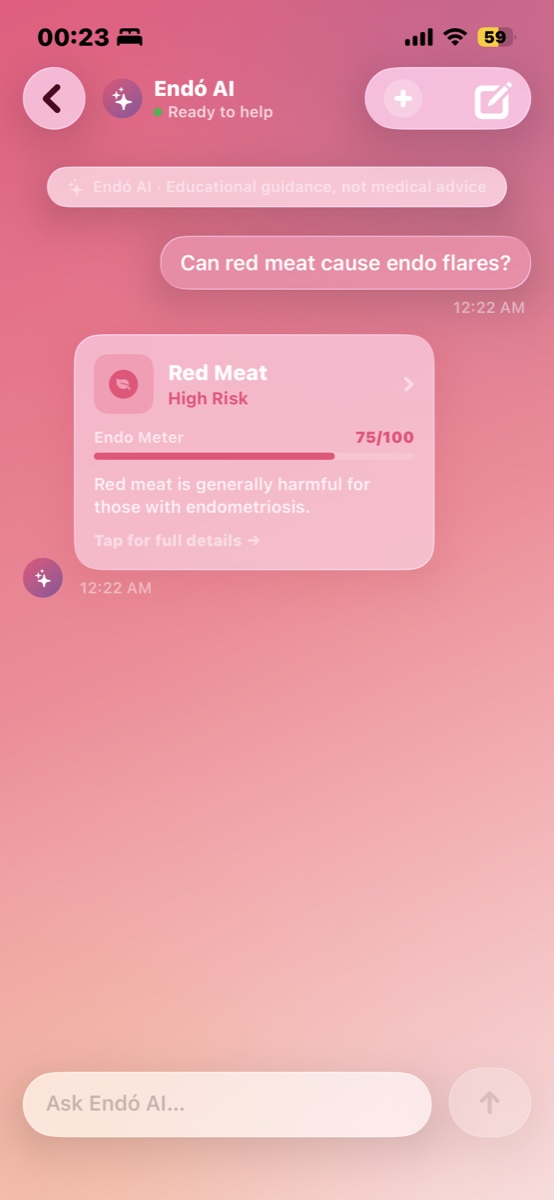
Answers, with the sources behind them
How it works
Four steps, at your own pace. Nothing here replaces a clinician — it gives you something concrete to show one.
Answer the questionnaire
56 symptoms, drawn straight from the study. Answer honestly about the past month — there are no wrong answers, and you can stop and come back.
See your symptom match
Endó shows which of your symptoms are the ones most strongly associated with endometriosis in the research, and which are not. A match is not a diagnosis or a score.
Log day by day
Track pain, symptoms, mood and period flow, with your cycle day and phase alongside them. A minute a day builds the record.
Bring it to your doctor
Months of structured symptom history in one place — the kind of record that is hard to reconstruct from memory in a ten-minute appointment.
The research behind the matching
Endó's symptom matching is drawn from one specific peer-reviewed study.
Goldstein, A. & Cohen, S. (2023). Self-report symptom-based endometriosis prediction using machine learning. Scientific Reports, 13, 5499.
- women surveyed
- 886
- with a diagnosis
- 474
- symptoms compared
- 56
The authors surveyed 886 women — 474 with a diagnosis of endometriosis and 412 without — asking each of them which of 56 symptoms they had experienced in the past month. That gave them, symptom by symptom, how much more often each one shows up in the diagnosed group than the undiagnosed one.
Those published per-symptom frequencies are what Endó's questionnaire is built on. When you answer, the app compares your pattern against them and shows you which of your symptoms are the ones most strongly associated with endometriosis in that study — and which are not.
The study was approved by the ethics committee of Ariel University, and is open access, so you can read the whole thing yourself. Its own limitations are worth knowing: participants were recruited through Facebook groups rather than clinics, and some women in the undiagnosed group may have undiagnosed endometriosis.
Everything you need to know
Can't find what you're looking for? We read every email.
No. Endó is an educational symptom-matching and tracking tool, not a medical device and not a diagnosis. A symptom match is not a result, a risk score, or a prediction. Only a qualified clinician can diagnose endometriosis — always talk to a healthcare professional about your symptoms.